If hours at a desk or on your phone leave your neck tight, shoulders rounded, and upper back aching, you’re not alone. I’ve battled that same achy, hunched feeling—until I tried a simple, equipment‑light yoga routine inspired by the internet’s favorite yoga instructors. It focuses on opening the chest, mobilizing the upper (thoracic) spine, and gently strengthening the muscles that hold you upright. Do it consistently and you’ll feel taller, breathe easier, and ease that stubborn mid‑back tension.
Disclaimer: If you have acute pain, numbness, tingling, or a recent injury, check with a healthcare professional before starting. Move within a pain‑free range and stop if something feels sharp or unstable.
Why posture hurts—and how yoga helps
– Modern posture is a load problem, not a “character flaw.” Long, static hours in one position—keyboard forward, shoulders up by the ears—overwork your neck and underwork your mid‑back and deep core.
– Yoga can restore balance by: (1) mobilizing the thoracic spine (where most of our rotation and extension should come from), (2) opening tight chest and front‑of‑shoulder tissues, and (3) lightly strengthening the postural chain (mid‑back, lower traps, rear delts, deep core) so you can hold good alignment without strain.
– Bonus: Breath‑led movement downshifts your nervous system, which often reduces muscle guarding and pain sensitivity in the upper back and neck.
What you’ll need
– A mat or carpeted floor
– Optional: yoga strap or long towel, a block or thick book, a wall, and a foam roller or two tennis balls in a sock
How often to do this routine
– Quick reset: 10 minutes daily on workdays (think coffee break or mid‑afternoon slump)
– Deep relief: 15–20 minutes, 3–5 days per week
– Expect early wins (less stiffness, easier breathing) in 1–2 sessions, with posture changes and pain relief building over 2–4 weeks
The 15‑minute posture and upper‑back routine
Move slowly and breathe through your nose. Aim for 3–5 deep breaths in each position unless noted. If you’re short on time, star the moves you’ll keep for a 10‑minute express flow.
1) Seated belly breathing + shoulder rolls (1 minute)
– Sit tall on a block or folded blanket. One hand on chest, one on belly. Inhale wide and low into your ribs; exhale long and slow.
– Add 5–8 shoulder rolls backward to “drop” the shoulders away from your ears.
2) Neck nods and side bends (1 minute)
– Gentle yes/no nods, then ear‑to‑shoulder stretches. Keep your jaw soft and shoulders heavy.
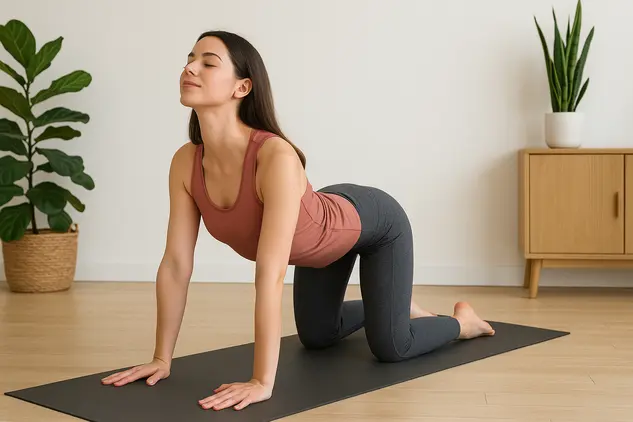
3) Cat–Cow (Marjaryasana/Bitilasana) (1 minute)
– On all fours, inhale to cow (heart forward, sit bones lift), exhale to cat (press floor away, round upper back). Think “move from the chest, not just the low back.”
4) Thread the Needle (1–2 minutes)
– From tabletop, slide right arm under left, resting on shoulder and side of head. Hips stack over knees. Breathe into your back ribs. Switch sides.
5) Puppy Pose (Anahatasana) or Wall Overhead Reach (1–2 minutes)
– Knees under hips, walk hands forward, melt chest toward mat, keep ribs gently knitted so the bend lands mid‑back, not low back.
– No kneeling? Face a wall, hands on wall at shoulder width, step back and hinge at hips as you send chest toward floor.
6) Sphinx to Low Cobra (Bhujangasana) (1–2 minutes)
– Lie prone, forearms down (Sphinx). Pull elbows back to broaden collarbones. Option to lift lightly into Low Cobra: pubic bone heavy, ribs knit, crown reaching forward. Keep glutes soft; the effort is in your back and lower traps, not your low back.
7) Cactus Arms on the floor (30–45 seconds each side)
– Lying face‑down, extend right arm at shoulder height, elbow bent 90° (cactus). Roll gently onto that side to stretch pecs/anterior shoulder. Repeat other side. Adjust angle for comfort.
8) Shoulder Flossing with Strap/Towel (1 minute)
– Hold a strap wide, arms straight. With soft ribs, sweep arms overhead and back as far as comfortable, then return. Go slow, keeping shoulders down. Reduce strap width over time as mobility improves.
9) Cow Face Arms (Gomukhasana Arms) (1 minute total)
– One hand overhead, one behind the back; hold strap between hands if they don’t meet. Keep neck long. Switch sides after 30 seconds.
10) Prone W–T–Y lifts (Strength) (2 minutes)
– Lie face‑down, forehead on a folded towel. Squeeze shoulder blades toward back pockets.
– W: Elbows bent by sides; lift arms an inch, hold 2 seconds, lower (6–8 reps).
– T: Arms straight out to sides, thumbs up; lift and hold (6–8 reps).
– Y: Arms overhead in a V; lift less height, focus on lower traps (6 reps).
– Keep chin slightly tucked and ribs heavy so the movement comes from the mid‑back, not your neck or low back.
11) Bird Dog (Core + Posture) (1 minute)
– From tabletop, reach opposite arm and leg long; pause 3 breaths, switch. Keep hips level. Imagine the crown of your head and heel moving away from each other.
12) Child’s Pose with Side Bend (30–45 seconds each side)
– From Child’s Pose, walk hands to the right to open left ribs; breathe into your side body. Switch sides.
13) Supine Figure‑Four or Doorway Pec Stretch (1–2 minutes)
– Figure‑four for hips (because tight hips tug your spine), or face a doorway and place forearm on the jamb at 90°, step through gently to open your chest. Hold 30–45 seconds each side.
14) T‑Spine Extension on Block or Foam Roller (1–2 minutes)
– Lie with a block (lowest height) or foam roller across your upper back (bra‑strap line). Support your head. Allow upper back to drape as you breathe. Keep ribs stacked over pelvis; avoid dumping into the low back.
15) Posture Reset + Box Breath (1 minute)
– Stand tall: feet hip‑width, ribs over pelvis, shoulders down, chin slightly tucked as if holding a peach under your chin. Inhale for 4, hold 4, exhale 4, hold 4. Repeat twice. Memorize this feel.
10‑minute express version
– Seated breathing + shoulder rolls (1 minute)
– Cat–Cow (1 minute)
– Thread the Needle (1 minute)
– Puppy or Wall Reach (1 minute)
– Sphinx to Low Cobra (1 minute)
– Strap shoulder flossing (1 minute)
– Prone W–T–Y (2 minutes)
– Bird Dog (1 minute)
– T‑Spine extension on block/roller (1 minute)
– Posture reset + box breath (1 minute)
Pro tips that make a big difference
– Use the 20‑8‑2 rule: Every 30 minutes at your desk, spend 20 minutes sitting, 8 minutes standing, and 2 minutes walking or doing 2–3 of the drills above.
– Stack your screen: Top of your monitor at eye level, forearms supported at 90°, feet flat, hips slightly higher than knees.
– Micro‑cues: Place a sticky note that says “Ribs over pelvis” or set a phone reminder to roll your shoulders back every hour.
– Breathe into your back: During stretches, aim each inhale into the back ribs—this helps your thoracic spine actually move.
– Pain scale: Stay under a 3/10. Tingling or sharp pain is your stop sign.
– Warmth helps: A brief warm shower or a heating pad across the upper back before the routine can make tissues more receptive.
– Pair with strength: Twice a week, add rows, face pulls, reverse flyes, and farmer’s carries to build durable posture support.
– Walk more: A 10–20 minute brisk walk opens your chest naturally and counteracts sitting.
– Phone posture: Bring the screen up to your eyes, not your head down to the screen.
– Sleep setup: A medium pillow that supports your neck (not just your head) keeps your spine happier by morning.
Common mistakes to avoid
– Shrugging during strength moves: Keep space between ears and shoulders to target the right muscles.
– Overarching your low back: Knit the ribs slightly to focus motion in your mid‑back where you need it.
– Rushing: Mobility changes respond to slow, sustained breathing—not speed.
– Going only for stretches: Balance openers with light strengthening so new range of motion sticks.
Who should modify or skip certain moves
– Shoulder impingement or rotator cuff irritation: Go lighter on overhead work; emphasize Sphinx, Thread the Needle, and gentle strap work kept in a pain‑free arc.
– New or postpartum: Prioritize breath, gentle mobility, and Bird Dog before adding prone lifts.
– Osteoporosis/osteopenia: Avoid aggressive spinal flexion; keep motion gentle and consult your provider.
Results you can expect—and when
– Immediate: A sense of space across the chest and easier, deeper breaths.
– 1–2 weeks: Less end‑of‑day neck and shoulder tension; better awareness of slouching.
– 3–4 weeks: Noticeably improved posture endurance and a calmer, less reactive upper back—especially if you combine the routine with an ergonomic setup and brief movement breaks.
FAQs
– How long should each session be? 10–20 minutes works well. Consistency beats marathon sessions.
– Morning or evening? Whenever you’ll actually do it. Morning primes good alignment; evening unwinds screen stress.
– Can yoga replace strength training? For posture, it’s a powerful start. For long‑term resilience, add 2 days of pulling work (rows/face pulls) and carry variations.
Your stronger conclusion and next steps
Your upper back doesn’t need heroic willpower—it needs better inputs, repeated often. This short, thoughtful routine gives you three things the modern desk life takes away: mid‑back mobility, open shoulders, and quiet strength in the muscles that hold you tall. Pair it with smarter desk habits and a couple of weekly pulling exercises, and you’ll transform “I should sit up straight” from a fleeting thought into something your body does naturally.
Start today: Pick the 10‑minute express version and set a repeating reminder on your calendar. After two weeks, progress to the full 15–20 minutes and add a weekly row/face‑pull session. In a month, you’ll feel the difference every time you glance in a mirror or finish a long workday—lighter, taller, and pain‑free across your upper back.
Editor’s note: This article offers general information only and is not a substitute for medical advice. If you have persistent or severe symptoms, consult a licensed healthcare professional.