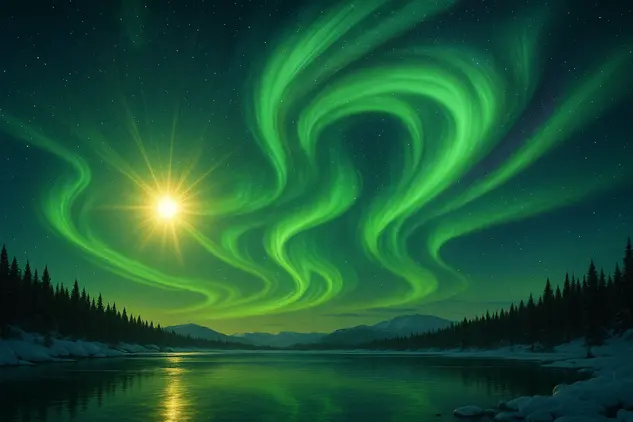
If your feeds have been flooded with glowing curtains of green, pink, and violet sky lately, you’re not imagining it—auroras have been unusually active and, at times, visible far beyond their usual Arctic haunts. What you’re seeing is space weather in action. As the Sun ramps up toward the peak of its 11‑year cycle, it’s sending more bursts of energy and plasma toward Earth, setting the stage for some of the most memorable Northern Lights of the decade.
Here’s what’s going on, why it matters, and how to safely maximize your chances of seeing—and photographing—the aurora wherever you live.
What is an aurora, really?
Auroras (aurora borealis in the Northern Hemisphere and aurora australis in the Southern Hemisphere) are the visible glow that happens when charged particles from the Sun collide with gases high in Earth’s atmosphere. Guided by Earth’s magnetic field toward the poles, these particles slam into oxygen and nitrogen between roughly 60 and 300 kilometers up, exciting the atoms and molecules. As they relax, they emit light:
– Green (most common): oxygen around ~100–150 km.
– Red: oxygen above ~200 km.
– Purple/pink/blue fringes: nitrogen at lower altitudes.
Why so many auroras now?
The Sun runs on an approximately 11‑year cycle, swinging from quiet “solar minimum” to stormy “solar maximum.” During the active years, we see more sunspots—dark, magnetically intense regions that can unleash solar flares and coronal mass ejections (CMEs). Flares are flashes of radiation; CMEs are giant clouds of magnetized plasma hurled into space. When a CME is aimed at Earth, it can disturb our planet’s magnetic field and kick off a geomagnetic storm. Coronal holes—openings in the Sun’s magnetic field—also send high‑speed solar wind streams that can intensify auroras, especially when they interact with slower solar wind ahead of them.
The strength of a geomagnetic storm is commonly summarized by the Kp index, which runs from 0 (quiet) to 9 (extreme). Higher Kp values mean the auroral oval expands away from the poles, making lights visible at lower latitudes than usual.
Where and when can you see the aurora?
– Usual hotspots: Alaska, northern Canada, Iceland, Norway, Sweden, and Finland enjoy frequent displays. In the U.S. lower 48, states along the Canadian border—Washington, Idaho, Montana, North Dakota, Minnesota, Wisconsin, Michigan, Vermont, New Hampshire, and Maine—are prime.
– During stronger storms: At Kp 6–7, the aurora can slip into the northern Plains and Great Lakes, sometimes reaching New York, Pennsylvania, and the Pacific Northwest. At Kp 8–9, faint glow can reach much farther south; on rare nights the lights may be visible on the horizon from the central U.S., and exceptionally even the Deep South.
– Best timing: Aim for local midnight to 2 a.m., but strong substorms can pop earlier in the evening and just before dawn. If a CME arrives around sunset, be ready as darkness falls and stay flexible—activity often comes in waves.
– Sky conditions: Darkness and clear skies matter as much as space weather. Urban light pollution and bright moonlight can wash out faint pillars. New‑moon weeks with crisp, dry air are your friend.
How to read the space‑weather tea leaves (without a Ph.D.)
A few simple signals greatly improve your odds:
– Short‑term alerts: Follow official updates from the Space Weather Prediction Center (NOAA SWPC). Watch for watches/warnings of geomagnetic storms labeled G1 to G5 (G5 is extreme).
– Kp index: A forecast or real‑time Kp of 5 (G1) means auroras may reach the northern U.S.; Kp 7+ can push them deeper south. Treat Kp as guidance, not a guarantee.
– Bz matters: Real‑time solar‑wind data from spacecraft upstream of Earth (often shown as IMF Bz) is crucial. When Bz points south (negative) and stays there, Earth’s magnetic field more easily reconnects with the solar wind, supercharging auroras.
– Speed and density: Higher solar‑wind speed and density help fuel sustained displays. Spikes often precede bright outbursts.
Practical tips: Plan, shoot, and stay safe
Monitoring and planning
– Track alerts: Enable push notifications from reputable sources and apps that mirror NOAA SWPC data or display real‑time solar wind.
– Check clouds and darkness: Use your favorite weather app and a light‑pollution map. If the Moon is bright, aim for the darkest horizon and look for stronger storms.
– Be patient: Substorms can ebb and flow. Give yourself at least an hour on location; your eyes need 15–20 minutes to adapt to darkness.
– Pick your spot: A north‑facing shoreline, open field, or hilltop with a clear horizon is ideal in the Northern Hemisphere. For the Southern Hemisphere, favor a south‑facing view.
Phone and camera settings that work
– Phones (Night/Pro mode):
– Stabilize with a tripod or a rock; use a 2–5 second timer to avoid shake.
– Start with 3–10 second exposures at ISO 800–3200. If streaks blur, shorten the exposure.
– Lock focus at infinity if possible; turn off flash and HDR; try the ultrawide lens for sweeping curtains.
– Shoot RAW (if supported). Lower white balance to ~3500–4000K for more natural greens.
– Mirrorless/DSLR:
– Lens: wide and fast (14–24mm, f/1.4–f/2.8).
– Settings: ISO 1600–6400, shutter 2–10 seconds, aperture wide open. Adjust shutter first to balance sharp rays vs. brightness.
– Focus: manual, using live‑view magnification on a bright star. Tape the ring to prevent drift.
– Stability: sturdy tripod, remote release, or 2‑second self‑timer. Turn off image stabilization on tripod.
– Composition: include foreground (trees, cabins, lakes) for scale. Bracket exposures for bright pillars.
– File format: shoot RAW for color latitude; avoid over‑saturation in editing.
Safety and etiquette at night
– Do not stop on active roadways; use designated pull‑offs and keep hazard lights on briefly.
– Dress in layers, cover extremities, and pack a thermos. Hypothermia sneaks up fast when you’re standing still.
– Use a red headlamp to preserve night vision and avoid blinding others.
– Respect private property and local communities; keep noise down late at night.
Protecting your tech and travel plans
– Power and electronics: Geomagnetic storms primarily affect long conductors (power lines, pipelines) and high‑altitude or polar routes. Everyday gadgets are rarely at risk. If conditions are extreme and your power flickers, unplug sensitive equipment and use surge protection.
– Navigation and comms: GPS accuracy can degrade during strong storms, and HF radio can be disrupted. If your work depends on precise positioning, build in buffers or check official advisories.
– Flights: Airlines sometimes alter polar routes during severe space‑weather events to maintain reliable communications. For most passengers, the impact is limited to potential rerouting.
Common myths—debunked
– “Auroras are dangerous to watch.” The light itself isn’t harmful. The broader storm can affect technology, but standing under the sky is safe.
– “You can predict auroras weeks in advance.” Long‑range outlooks hint at active periods, but the most reliable forecasts are 1–3 days out (for CMEs) and minutes to hours for real‑time signals like Bz.
– “They only happen in deep winter.” Dark, clear nights help, but auroras occur year‑round. Summer at high latitudes simply has too much daylight to see them.
– “They’re always green.” Greens dominate, but strong storms often add reds and purples, especially on the edges and tops of curtains.
Quick glossary for first‑timers
– Sunspot: A magnetically active region on the Sun’s surface; often the source of flares and CMEs.
– Solar flare: A burst of electromagnetic radiation; can cause radio blackouts on the sunlit side of Earth.
– Coronal mass ejection (CME): A cloud of magnetized plasma shot from the Sun; a major driver of geomagnetic storms.
– Coronal hole: A region where solar magnetic fields open to space, emitting high‑speed solar wind.
– Geomagnetic storm: A global disturbance of Earth’s magnetic field. Rated G1 (minor) to G5 (extreme).
– Kp index: A 0–9 scale summarizing global geomagnetic activity; higher numbers bring auroras farther from the poles.
– IMF Bz: The north‑south orientation of the solar wind’s magnetic field. Sustained southward (negative) Bz is aurora‑friendly.
Why this matters beyond the wow factor
Auroras are the visible edge of a complex system that affects satellites, power grids, and communications. Strong storms can increase drag on low‑Earth‑orbit satellites, interfere with HF radio used over oceans and polar regions, and induce currents in long conductors. Grid operators, satellite teams, and aviation managers actively monitor these conditions and prepare accordingly. For the rest of us, the practical takeaway is to plan smartly, stay informed, and enjoy a rare natural spectacle when it comes to us.
Stronger conclusion: Make this solar peak count
We’re in the heart of an unusually lively solar cycle, and that means more opportunities to witness the northern (and southern) lights without traveling to the Arctic. The formula for success is simple: follow credible space‑weather alerts, chase clear dark skies, arrive early and stay patient, and go in with a plan for photography and safety. Whether you’re in Alaska or Alabama, a modest storm can paint the northern horizon; a major one can turn the whole sky into a slow‑motion river of color.
Before the next headline‑grabbing storm arrives, do three things: set up alerts from NOAA SWPC or a trusted app, scout a dark‑sky location with a clear north‑facing view, and pack a small night kit (tripod, headlamp, spare batteries, warm layers). When the Bz tips south and the Kp climbs, you’ll be ready to step outside and experience one of Earth’s great natural performances—no plane ticket required.
FAQs
– Can I see the aurora from my city? If you live in the northern tier of the U.S., you have a fair chance a few times each solar cycle. Farther south, focus on strong storms (Kp 7+), look low on the northern horizon, and get away from city lights.
– What time should I go? Be on site by 9–10 p.m. and plan to stay past midnight. Substorms often surge around local midnight, but big storms can light up the sky earlier.
– How long does a display last? Individual bursts may last minutes; active nights can pulse for hours. If a CME arrives, the first night and the one after can both deliver.
– Do I need special glasses? No. Unlike solar eclipses, you can view auroras with the naked eye.
– What about the Southern Hemisphere? The aurora australis favors Antarctica, Tasmania, and New Zealand’s South Island. In Australia and New Zealand, look south toward a dark ocean horizon during active nights.
The bottom line: Keep your expectations realistic, prepare your plan, and let the Sun surprise you. With the solar cycle near its peak, this is the best window in years to catch the aurora—wherever the storm takes it next.