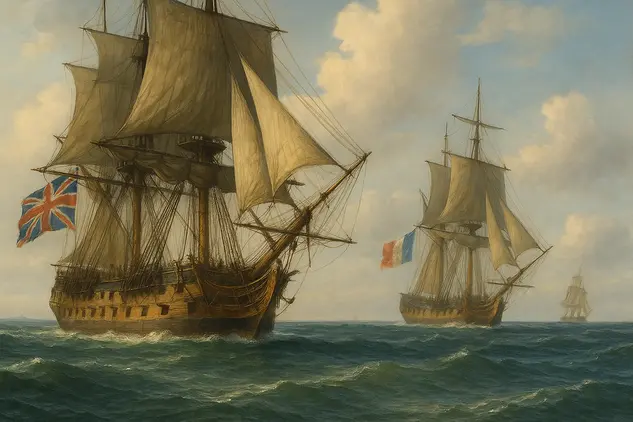
A quiet debate has been building in European defense circles: has the Royal Navy ceded its traditional edge to France’s Marine Nationale? The answer isn’t a simple yes or no. It depends on what you measure—carriers, submarines, escorts, readiness, industry, people—and how you weigh numbers against availability and expeditionary punch. Here’s a clear, practical, and SEO-friendly guide to what’s really changing at sea, why it matters, and how to follow it intelligently.
Why this matters now
– Global trade rides on secure sea lanes. Energy, food, and critical minerals still move mostly by ship.
– Europe’s deterrence depends on credible maritime power for NATO’s northern flank, the Atlantic, and the Mediterranean.
– The Indo-Pacific tilt, Red Sea disruptions in 2023–2024, and undersea infrastructure threats raise the premium on ready, sustainable fleets.
Quick baseline: what to watch when judging navies
Counting hulls alone misleads. A modern scorecard weighs:
– Availability and readiness: how many ships are actually ready today?
– Air wing strength: aircraft on deck, munitions, and sortie generation.
– Undersea edge: SSBN credibility, SSN stealth, weapons, and crew proficiency.
– Escort quality and air-defense coverage: sensors, missiles, and electronic warfare.
– Amphibious and logistics depth: lift, replenishment, and repair capacity.
– Industrial cadence: can yards deliver on time and upgrade quickly?
– People: recruitment, retention, and specialized skills.
Carrier power: mass versus launch method
– United Kingdom: Two Queen Elizabeth–class carriers (STOVL) provide rare capacity—having two decks confers resilience and the option for sustained presence. Embarked air wings center on F-35B stealth fighters supported by Merlin helicopters and CROWSNEST airborne surveillance. Strengths: survivable airframe, low-observable strike, and the strategic flexibility of twin carriers. Trade-offs: STOVL limits catapult-launched aircraft like heavy AEW or tankers, putting more pressure on deck cycles and rotary-wing ISR.
– France: One CATOBAR carrier, Charles de Gaulle, with Rafale M fighters and robust sortie-generation via catapults. Strengths: mature, high-tempo launch and recovery; carrier-borne fighters optimized for heavy loads and range. Trade-offs: single-deck risk; when in deep refit, France lacks organic carrier aviation at sea. A successor (PANG) is planned for the 2030s, aiming to preserve a high-end CATOBAR capability with next-generation systems.
Bottom line: The UK’s twin-deck advantage is real for presence and redundancy; France’s CATOBAR brings pure aviation performance. Who’s “ahead” depends on whether you prize constant availability (UK) or peak deck performance per ship (France).
Undersea deterrent and attack submarines
– Strategic deterrent (SSBN): Both navies maintain continuous at-sea deterrence with ballistic missile submarines—Vanguard-class for the UK heading toward the Dreadnought-class, and Triomphant-class for France preparing for its SNLE 3G successor. Reliability and quieting are closely guarded, but both forces are regarded as credible and professional, with tight patrol discipline.
– Attack submarines (SSN): The UK’s Astute-class is a highly capable, long-ranged, and quiet hunter-killer platform with advanced sensors and cruise-missile strike options. France’s Suffren-class (Barracuda program) brings new stealth, payload flexibility, and modern combat systems. Fleet sizes are comparable in the single digits, with the UK and France each aiming to stabilize production cycles and keep boats out of extended overhauls. The UK’s future SSN-AUKUS design signals long-term ambition but also industrial complexity; France’s Barracuda ramp emphasizes evolutionary improvements through a steady program.
Bottom line: It’s a near-peer matchup undersea. The Royal Navy retains deep expertise in long-range operations and Anglo-American undersea integration, while France’s latest SSNs are widely respected for stealth and contemporary design.
Surface escorts: numbers, sensors, and staying power
– United Kingdom: The fleet is transitioning. Type 45 destroyers offer excellent area air defense and powerful radars. The aging Type 23 frigates are giving way to the high-end Type 26 (ASW-focused, with advanced quieting) and the more numerous, cost-controlled Type 31 for presence and general duties. Across the transition, the escort count dips before recovering as new hulls deliver. Modernization of missiles, sonar, and electronic warfare is central to keeping the force lethal.
– France: A balanced, modern mix centers on FREMM multipurpose and ASW variants, Horizon-class air-defense destroyers, and the newer FDI (defense and intervention) frigates. The French surface force emphasizes contemporary sensors, integrated combat systems, and strong anti-submarine credentials in the Atlantic and Mediterranean. Availability and crew proficiency are recurring strengths, supported by methodical upgrade cycles.
Bottom line: The UK is trading short-term numbers for long-term capability, betting on Type 26/31 to stabilize the escort force. France presents a coherent, modernized surface mix with solid availability. The “lead” depends on timing—delivery schedules versus today’s ready hulls.
Amphibious, logistics, and global posture
– United Kingdom: Amphibious lift includes Albion-class assault ships and Bay-class vessels, aligned to Littoral Response Groups. The Royal Fleet Auxiliary underwrites reach with tankers, solid support, and specialized ships that enable the carriers and escorts to stay on station. The UK’s network touches the North Atlantic, Mediterranean, Gulf, and an Indo-Pacific tilt with forward presence and exercises.
– France: The Mistral-class LHDs provide helicopter assault, command-and-control, and humanitarian response. Logistics are strengthening with new replenishment ships (BRF) to back longer operations. France’s global posture is anchored by overseas territories and exclusive economic zones from the Caribbean to the Indo-Pacific, supporting year-round presence from the Indian Ocean to the Pacific.
Bottom line: Both navies bring credible expeditionary toolkits. The UK leans on carrier-enabled strike and RFA depth; France leverages versatile LHDs and a global footprint tied to its overseas departments and territories.
People and readiness: the decisive variable
Ships don’t sail themselves. Both navies face recruitment, retention, and specialized-skills challenges—nuclear engineers, acoustic analysts, avionics technicians, and cyber specialists are especially scarce. Readiness gaps—whether from manpower, maintenance, or munitions stockpiles—can erase paper advantages. France has cultivated a reputation for steady availability through incremental modernization and training tempo; the UK is pushing to stabilize crew pipelines while keeping two big carriers and a nuclear enterprise fully manned.
Industrial base and budgets
Industrial rhythm determines whether fleets grow, shrink, or tread water.
– United Kingdom: A revitalized shipbuilding strategy aims to smooth production of Type 26 and Type 31 and to sustain submarine expertise through Dreadnought and follow-on SSNs. Timely delivery, workforce development, and supply-chain resilience remain the watchwords.
– France: Naval Group and partners have tended steady output of FREMM, FDI, and Barracuda submarines, with a modernization arc mapped through the 2030s (including PANG and SNLE 3G). The French model emphasizes predictable multi-year funding and incremental upgrades.
Across both countries, defense spending has increased since 2022, but inflation, materials, and learning-curve effects can eat into planned gains. Success hinges on on-time delivery and the unglamorous work of sustainment.
So, who’s actually ahead—Britain or France?
– Carriers: Advantage UK for two decks and global presence; advantage France for CATOBAR performance per deck.
– Submarines: Rough parity at the high end; distinct design paths with complementary strengths.
– Escorts: France currently benefits from a tightly modernized mix; the UK’s modernization path should pay off as new classes come fully online.
– Expeditionary and logistics: Both are credible; the UK leans on RFA depth and carriers, France on LHD flexibility and global basing tied to overseas territories.
– Readiness and people: The deciding factor. Day-to-day availability, crew retention, and magazine depth (missiles and spares) determine real power.
The narrative of “decline” is too simplistic. The Royal Navy remains a top-tier force navigating a difficult modernization crossover. France is capitalizing on steady programs to field a balanced, highly available fleet. In practice, European maritime security gains most when these two cooperate—and they do, frequently.
What this means for NATO, Europe, and the wider world
– Deterrence: Two nuclear powers with credible SSBN forces complicate any adversary’s calculus in the Atlantic and Mediterranean.
– Presence: Twin British carriers enable more persistent deployments; France adds flexible, rapid-response capacity with LHDs and modern escorts.
– Interoperability: UK–France cooperation under the Combined Joint Expeditionary Force (CJEF) and NATO frameworks amplifies effect. Shared exercises and compatible data links, procedures, and munitions matter as much as new hulls.
Practical tips: how to follow this story like a pro
– Track availability, not just fleet lists: Look for how many carriers, escorts, and submarines are actually at sea and fully crewed.
– Read official documents: UK parliamentary committee reports, National Audit Office assessments, France’s defense white papers and procurement updates offer ground truth.
– Watch industrial cadence: Delivery milestones for Type 26/31 (UK) and FDI/FREMM/Suffren (France) tell you where each navy is headed.
– Prioritize munitions and sensors: Ask whether ships carry the latest air-defense missiles, ASW weapons, towed arrays, and electronic warfare suites.
– Compare air wings honestly: Count aircraft typically embarked, not just theoretical capacity; note AEW, ISR, and tanker support.
– Mind the crew pipeline: Retention bonuses, apprentice programs, and training throughput foreshadow future readiness.
– Use credible trackers: Annual resources like The Military Balance, Jane’s, and official navy releases are more reliable than social media snapshots.
– For investors and industry watchers: Follow order books and sustainment contracts for BAE Systems, Babcock, Naval Group, Thales, MBDA, and Rolls-Royce (nuclear) as indicators of momentum. Do your own diligence; defense cycles are long and political.
– For students and job seekers: Skills in marine engineering, nuclear systems, software, AI, acoustics, and cybersecurity are in demand. Explore apprenticeships and graduate schemes at major yards and integrators.
FAQ: quick answers to common questions
– Is the Royal Navy smaller than ever? It’s smaller than its Cold War peak, but that’s not the right comparison. Today’s ships are far more capable per hull. The issue is balancing modernization with day-to-day readiness.
– Has France overtaken the UK at sea? On some metrics—modern escort coherence and availability—France has a current edge. On others—dual carriers, nuclear submarine depth, and global presence—the UK retains distinct advantages.
– Can they fight together effectively? Yes. UK and French units operate together often, share NATO standards, and train under the CJEF framework for rapid combined operations.
– What could change the balance? On-time delivery of new escorts, submarine availability, air-wing maturation (including more F-35Bs for the UK and Rafale M upgrades for France), and munitions stockpiles will drive near-term outcomes.
Stronger conclusion: a race worth winning—together
Framing this as a zero-sum contest misses the strategic point. Britain and France are Europe’s maritime heavyweights, and both are upgrading for an age of contested seas, from the High North to the Indo-Pacific. The Royal Navy’s perceived “decline” reflects a modernization valley—not a loss of ambition or expertise. France’s steady rise is a lesson in coherent programs, incremental upgrades, and disciplined availability.
The true test isn’t whose flag flies from more masts, but whose ships sail, fight, and sustain day after day. On that score, the decisive variables are readiness, magazines, and crews. If London keeps its modernization on schedule and stabilizes manning—and if Paris sustains its procurement tempo and training edge—Europe will field two complementary naval spearheads. That outcome deters adversaries, reassures allies, and keeps the world’s sea lanes open. In the end, the smart competition is not UK versus France, but UK and France versus the problems that actually threaten maritime security: undersea infrastructure attacks, missile and drone swarms, and gray-zone pressure below the threshold of open war.
The bottom line for readers: Don’t get trapped by hull counts or hype. Follow availability, air wings, submarines, sensors, sustainment, and people. That’s where real naval power lives—and where the next decade’s winners will quietly pull ahead.